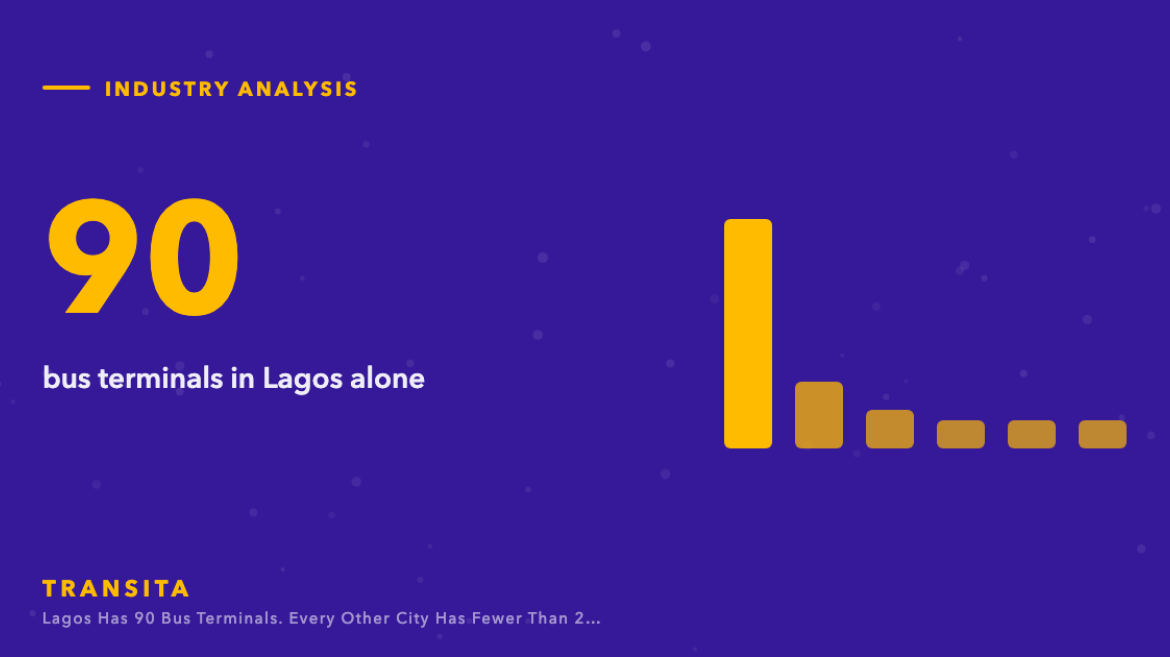
Lagos holds 90 of the 323 bus terminals recorded on the Transita index. Abuja, the next largest, has 26. No other city in Nigeria reaches 16. That is not a gentle gradient; it is a step function, and it shapes how the entire national network behaves.
Key takeaways
- Lagos: 90 terminals, 7 operators, 28% of all terminals on the index.
- Abuja is second with 26; the gap between first and second is larger than the gap between second and twelfth.
- All 7 national operators maintain multiple Lagos boarding points.
- Terminal choice within Lagos can cost or save more time than the inter-operator fare difference.
The distribution
| City | State | Terminals | Operators |
|---|---|---|---|
| Lagos | Lagos | 90 | 7 |
| Abuja | Abuja | 26 | 5 |
| Benin City | Edo | 15 | 6 |
| Enugu | Enugu | 11 | 6 |
| Aba | Abia | 11 | 7 |
| Port Harcourt | Rivers | 11 | 6 |
| Awka | Anambra | 10 | 6 |
| Owerri | Imo | 9 | 6 |
| Yenagoa | Bayelsa | 8 | 4 |
| Onitsha | Anambra | 7 | 6 |
| Umuahia | Abia | 7 | 5 |
| Uyo | Akwa Ibom | 7 | 6 |
Why so many
The obvious answer — Lagos is big — is incomplete. Kano and Ibadan are also large and do not have anything like this density. The real driver is that Lagos is geographically hostile to a single terminal. A city split by lagoon, with limited crossings and severe peak congestion, cannot be served from one loading point. An operator that puts its only Lagos terminal at Jibowu has effectively excluded island passengers and the western suburbs from a 5am departure.
So operators multiply boarding points instead: Jibowu and Yaba for the mainland core, the Festac–Amuwo–Okota–Mazamaza cluster on the western approach, Ajah and Lekki for the island, Ikotun and Iyana Ipaja to the north-west. Each is a response to a traffic constraint rather than a catchment in the ordinary sense.
What it means for the network
Terminal density in the origin city functions as capacity. A corridor served from eight Lagos boarding points can fill more buses than the same corridor served from two, because the effective catchment is larger. That is a large part of why the Lagos corridors carry the widest operator fields on the index — the city can absorb the supply.
It also explains a persistent asymmetry. Fares out of Lagos and fares into Lagos on the same corridor are frequently different, and the direction with more boarding points is usually the one with more competitive pressure on price.
What it means for you
Choose the terminal before you choose the operator. On most Lagos corridors the fare gap between carriers is smaller than the cost of crossing the city at dawn to reach the wrong loading point. A ₦3,000 fare saving is not a saving if it costs you two hours on Third Mainland Bridge and a missed departure.
Search by terminal, not just by route. Transita shows every Lagos boarding point on your corridor.
Frequently asked questions
How many bus terminals are in Lagos?
90 are recorded on the Transita index, served by all 7 national operators.
Which is the main bus terminal in Lagos?
Jibowu carries the most operators and is the default for mainland departures, but there is no single main terminal — the network is deliberately distributed across the city.
Which Lagos bus terminal should I use?
The one nearest where you will be the night before departure. On most corridors that matters more than the fare difference between operators.