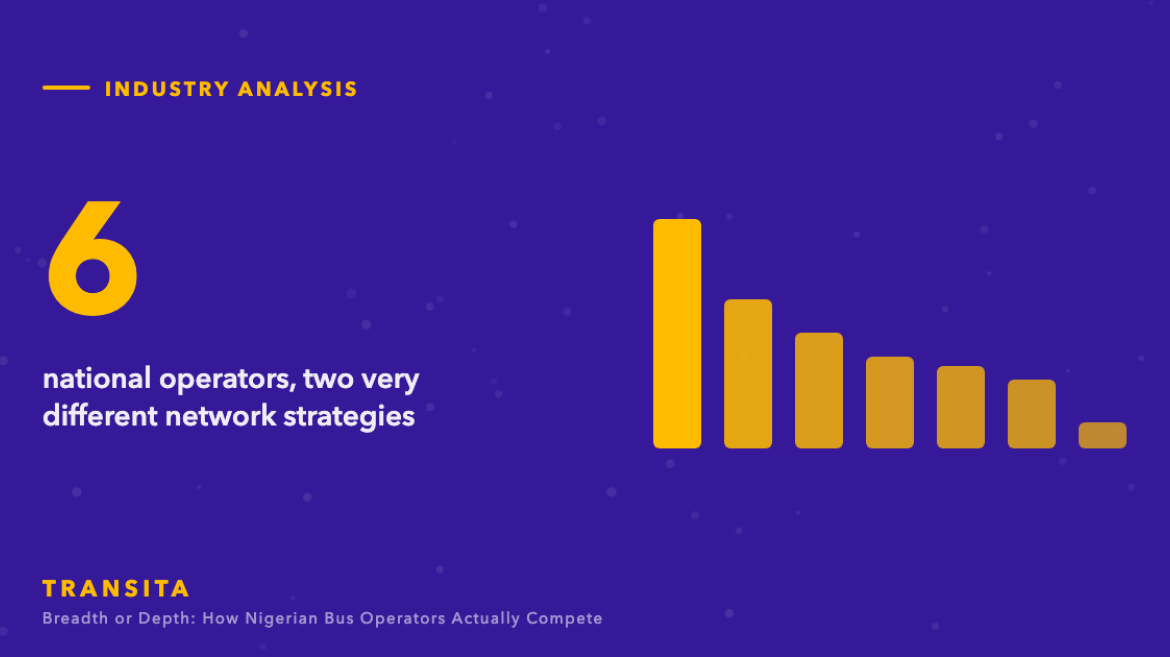
Fleet size is the number operators quote and the least useful one. What actually determines whether a carrier is usable is where it puts its terminals, and on that measure the 7 national operators on the Transita index have made visibly different bets.
Key takeaways
- 323 terminals across 61 cities and 28 states from 7 operators.
- The widest network covers 52 cities; the deepest averages 2.3 terminals per city it serves.
- Terminals per city is the better proxy for convenience; cities per state is the better proxy for reach.
The two strategies
| Operator | Terminals | Cities | States | Terminals per city | Cities per state |
|---|---|---|---|---|---|
| GUO Transport | 97 | 52 | 26 | 1.9 | 2.0 |
| GIGM | 63 | 27 | 22 | 2.3 | 1.2 |
| Libra Motors | 49 | 23 | 11 | 2.1 | 2.1 |
| Chisco Transport | 39 | 18 | 12 | 2.2 | 1.5 |
| ABC Transport | 35 | 21 | 19 | 1.7 | 1.1 |
| Peace Mass Transit | 29 | 19 | 14 | 1.5 | 1.4 |
| Efex Transport | 11 | 6 | 6 | 1.8 | 1.0 |
Breadth: get to the town first
The breadth strategy is to be present in as many places as possible and let the absence of alternatives do the selling. GUO Transport is the clearest example: the largest city count on the index by a distance, spread across 26 states, at a relatively low terminal density per city. It is the operator most likely to serve a town nobody else timetables, and consequently the sole carrier on more corridors than anyone else.
The cost of breadth is frequency. Coverage spread thin means fewer daily departures per point, and a terminal on the map is not the same as a bus this afternoon. Passengers should check the schedule rather than the network map.
Depth: own the corridor
The depth strategy concentrates on fewer places and puts multiple boarding points in each. GIGM runs the highest terminal-per-city ratio on the index. Libra Motors runs the most concentrated network of all — 49 terminals across only 11 states, almost entirely on the Lagos–southeast axis.
Depth is what produces a genuinely good passenger experience in a large city. Eight boarding points in Lagos means most travellers have one within a reasonable distance, which on a corridor where the bus leaves at 5am is worth more than a few thousand naira of fare difference.
The hybrid: governance as a strategy
ABC Transport sits apart from both. It is a listed company with the reporting obligations that come with that, and its network is the most southeast-weighted of the national carriers. Crucially, it is the only operator treating the regional southeast circuit as a product rather than as feeder traffic — running Enugu, Owerri, Calabar and Port Harcourt against each other at fares far below the long-haul average.
Peace Mass Transit is the fourth model: a regional operator that scaled without relocating its centre of gravity to Lagos. Its spine runs out of Enugu, and it prices the southeast as a home market rather than a destination.
What this means if you are choosing
- Travelling to a small town or a secondary state capital: check the broad-network operators first, because they may be the only ones there.
- Travelling a trunk corridor from a large city: check the deep-network operators, because the boarding point convenience is worth more than the fare gap.
- Travelling within the southeast: check the regional specialists, whose short-haul pricing is structurally lower than the national carriers’ long-haul-derived rates.
One search covers every operator. Compare network, fare and terminal together on Transita.
Frequently asked questions
Which bus company has the most terminals in Nigeria?
GUO Transport, with 97 terminals across 52 cities on the Transita index.
Which Nigerian bus operator covers the most states?
GUO Transport covers 26 states, the widest coverage on the index.
Which bus operator is best in Nigeria?
It depends entirely on the corridor. Broad-network carriers reach places others do not; deep-network carriers offer more boarding points and higher frequency on the routes they do run.