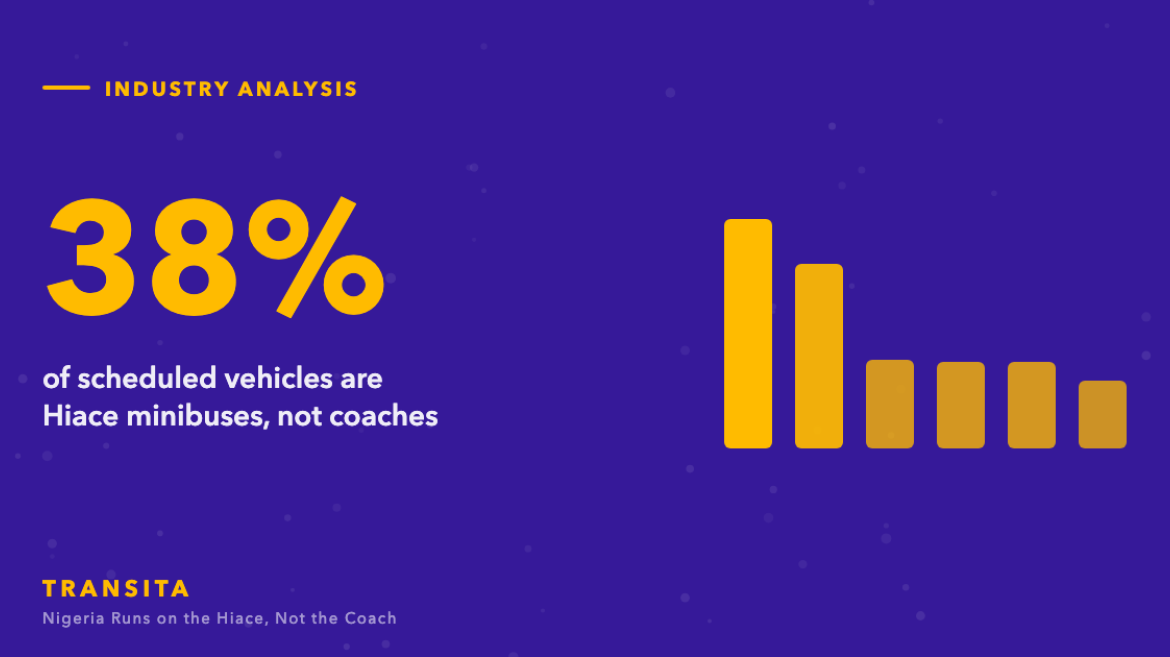
Ask anyone to picture intercity bus travel and they picture a coach. The Nigerian network does not run on coaches. Across 677 scheduled vehicle-class records on the Transita index, Hiace variants alone account for 38%. Full luxury coaches account for a small single-digit share.
Key takeaways
- Hiace variants: 38% of all scheduled vehicle-class records.
- Luxury coach and sleeper classes together are a small minority of scheduled service.
- The minibus model trades capacity per departure for frequency and flexibility.
- It also explains why Nigerian intercity fares are high per kilometre relative to coach markets.
The fleet mix
| Vehicle class | Scheduled records | Share |
|---|---|---|
| Hiace | 153 | 23% |
| Standard No/Ac | 123 | 18% |
| Sprinter | 59 | 9% |
| Hiace X | 58 | 9% |
| Jet | 58 | 9% |
| Hiace Ultra | 45 | 7% |
| Sienna | 32 | 5% |
| Toyota | 32 | 5% |
| Shuttle | 23 | 3% |
| Standard_Bus | 19 | 3% |
Why the minibus won
Three reasons, and none of them is that operators could not afford coaches.
Road conditions. A 50-seat coach needs consistent surface quality and generous turning geometry over hundreds of kilometres. A 14-seat minibus does not. On a network where surface quality varies substantially within a single journey, the smaller vehicle has a lower effective cost of unreliability.
Load risk. Filling a 14-seat vehicle is a much easier problem than filling a 50-seat one. On a thin corridor — and 74% of corridors on this network are single-operator, thin routes — the minibus is the only vehicle that makes the route viable at all. The coach needs a demand density most Nigerian corridors do not have.
Frequency. Four minibuses across a day serve passengers better than one coach at dawn, even at identical total capacity. In a market where travellers are choosing between operators partly on departure time, frequency is a competitive asset.
The cost consequence
The trade-off is unit cost. Fuel, driver and terminal costs per seat are higher in a 14-seat vehicle than a 50-seat one, and that is a large part of why Nigerian intercity fares run at a median of roughly ₦4,600 per hour of travel — high relative to coach-led markets at comparable income levels.
It also makes the network unusually exposed to fuel price movements. A coach-led operator can absorb some of a fuel shock across more seats. A minibus-led one cannot, which is exactly the pattern visible in the fare reset data.
Where the coaches are
Luxury coach and sleeper service concentrates almost entirely on the longest, densest corridors — the Lagos–Abuja and Lagos–southeast trunk routes, where demand supports the load factor a large vehicle needs. That is the correct deployment, and it is why the fare ceiling on those corridors is so much higher than the floor: you are not comparing two prices for one product, you are comparing two different products.
For a practical breakdown of what each class actually means for legroom, luggage and journey comfort, see our guide to Nigerian bus vehicle classes.
Compare fare and vehicle class together. Transita shows the class alongside the price, so you compare like for like.
Frequently asked questions
What kind of buses are used for intercity travel in Nigeria?
Predominantly Toyota Hiace and similar minibus variants, which account for around 38% of scheduled vehicle classes. Sprinters, Siennas and luxury coaches make up the rest.
Why are Nigerian bus fares high per kilometre?
Largely because the fleet is minibus-led. Fuel, driver and terminal costs spread across 14 seats rather than 50 produce a structurally higher cost per seat.
Are luxury coaches available in Nigeria?
Yes, but concentrated on the longest and busiest corridors where demand supports the load factor — principally Lagos to Abuja and the Lagos to southeast trunk routes.