The standard mental model of Nigerian intercity travel is a wheel: Lagos at the centre, Abuja as a second hub, spokes running out to everywhere else. It is a useful picture and it is wrong about most of the network.
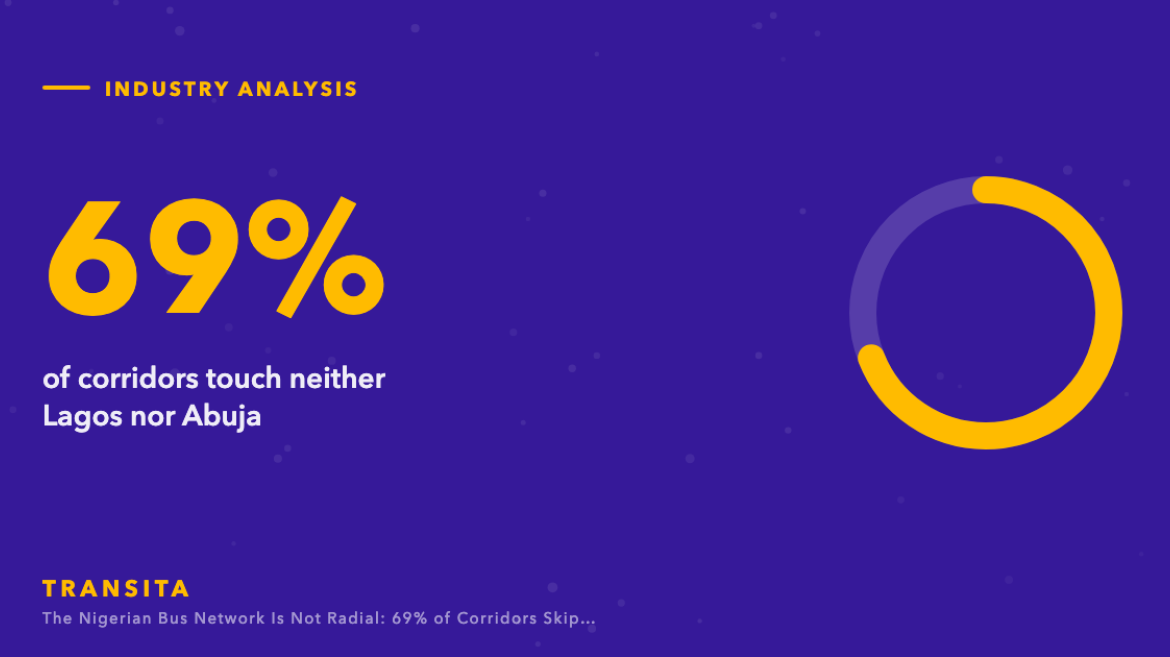
Of 208 city-pair corridors carrying live scheduled fares, 144 — 69% — involve neither Lagos nor Abuja. The regional network is not a footnote to the trunk network. By corridor count it is the larger of the two.
Key takeaways
- 144 of 208 corridors (69%) bypass both national hubs.
- Regional fares run far below trunk-route fares for comparable journey times.
- Most regional corridors are single-operator, so the choice is thin even where the service exists.
- The southeast regional circuit is the densest non-hub cluster on the index.
The regional corridors that are actually contested
| Corridor | Operators | Fare range | Median journey time |
|---|---|---|---|
| Aba – Benin City | 4 | ₦16,000 – ₦27,250 | 5 hours |
| Benin City – Owerri | 4 | ₦15,000 – ₦44,350 | 3 hours |
| Aba – Asaba | 3 | ₦8,000 – ₦27,500 | 2h 30m |
| Awka – Benin City | 3 | ₦15,000 – ₦24,150 | 3h 15m |
| Benin City – Enugu | 3 | ₦15,000 – ₦25,250 | 4 hours |
| Benin City – Port Harcourt | 3 | ₦15,000 – ₦57,650 | 4h 30m |
| Enugu – Port Harcourt | 3 | ₦13,000 – ₦22,500 | 4 hours |
| Port Harcourt – Uyo | 3 | ₦6,500 – ₦19,250 | 2 hours |
| Aba – Enugu | 2 | ₦7,000 – ₦15,000 | 3 hours |
| Aba – Ijebu Ode | 2 | ₦27,500 – ₦48,000 | 9 hours |
The southeast circuit
The densest non-hub cluster on the index is the southeast circuit: Enugu, Owerri, Aba, Umuahia, Port Harcourt and Calabar, connected to each other rather than only to Lagos. Fares here are a fraction of the trunk routes — short-haul links in the region run at a small share of what the same operators charge for a Lagos journey — and journey times are half-day rather than full-day.
This is a genuinely different product from long-haul intercity travel. It behaves more like a regional commuter network: same-day return is realistic, walk-up booking is viable, and demand is less seasonal. It is also the part of the network with the least visibility, because it is not what national operators market.
Why the radial story persists
Partly because trunk routes carry more passengers per corridor even if there are fewer of them. Partly because they are where the marketing spend goes. But mostly because regional corridors are hard to see: they are thin, single-operator, and rarely aggregated anywhere a passenger or an analyst would look.
That invisibility has a cost. Demand on regional links does not show up in any planning process, so the routes stay under-timetabled, which suppresses the demand further. It is a legible-market problem before it is a capacity problem — the argument we make in the case for a shared booking layer.
What it means for travellers
Two practical implications. First, if your journey is within a region, price the regional service rather than assuming you need a national carrier's long-haul product. Second, on longer journeys, price a split itinerary: a trunk leg to a regional hub plus a local connection is frequently cheaper than the through fare, particularly on the Lagos–southeast routes where Benin City and Asaba function as natural break points.
Search regional routes as easily as trunk routes. Transita indexes both in one place.
Frequently asked questions
Do Nigerian buses only run to and from Lagos?
No. 69% of corridors on the Transita index involve neither Lagos nor Abuja, including a dense regional circuit across the southeast.
What is the cheapest way to travel within the southeast?
Regional short-haul services between cities like Enugu, Aba, Umuahia and Port Harcourt cost a fraction of long-haul fares and are frequently faster than routing through a hub.
Is it cheaper to split a long bus journey?
Often, yes. On Lagos to southeast corridors, a ticket to Benin City or Asaba plus a local connection can undercut the through fare. Compare both before booking.